City Guides

Tsinari Area Thessaloniki

Tsinari Area Thessaloniki

There is a version of Thessaloniki that no travel guide fully captures, because it is not a monument or a museum but a neighbourhood that happens to be alive in a way that most old quarters in European cities are not. The Tsinari area Thessaloniki is the social and emotional heart of Ano Poli, the Upper Town. It is a small cluster of cobblestone streets, a square shaded by plane trees, a handful of tavernas that have been serving meze to the same neighbourhood for decades, and a pace of life that exists outside the rhythms of the modern city below. If you want to understand what daily life in old Thessaloniki actually feels like, the Tsinari area Thessaloniki is where that understanding begins.

The History of the Neighbourhood

A Name Under the Plane Trees

The name “Tsinari” comes from the Turkish word “cinar,” meaning plane tree. It refers to the large plane tree that once shaded the central square of this neighbourhood, a tree around which the social life of the quarter has revolved for generations. The Tsinari area Thessaloniki has been a gathering place since the Ottoman period, when the Upper Town was predominantly Turkish-speaking and the square served as the informal living room of the neighbourhood.

After the population exchange of 1923, when Greek refugees from Asia Minor and Pontus settled in Thessaloniki, the character of the neighbourhood shifted but its function remained the same. The square stayed the centre, the cafes stayed open, and the tradition of sitting, drinking, talking, and watching the evening arrive continued without interruption. The Tsinari area Thessaloniki is one of those rare urban spaces where the social use has outlasted every political and demographic change that the city has undergone.

Surviving the Fire

The Great Fire of 1917 destroyed approximately two-thirds of Thessaloniki’s city centre but stopped before reaching the slopes of Ano Poli. The Tsinari area Thessaloniki survived intact, preserving its Ottoman-era houses, narrow streets, and the intimate scale of its public spaces. While the lower city was rebuilt on a modernist grid designed by French architect Ernest Hebrard, the upper town kept its medieval layout. This accident of geography is why walking into the Tsinari area Thessaloniki today feels like crossing a threshold into a different century.

The Cafes and Tavernas

The Historic Tsinari Cafe

The most famous establishment in the Tsinari area Thessaloniki is the cafe-taverna that shares the neighbourhood’s name. Operating since 1885, it is considered one of the last surviving examples of an Ottoman-era cafe building in the city. The building itself is a piece of living heritage: low ceilings, wooden interiors, and a layout that has not fundamentally changed in over a century.

Today, the Tsinari cafe operates as both a traditional coffeehouse and a taverna, serving Greek coffee, tsipouro (the northern Greek grape spirit), local wine, and a menu of classic mezedes. Sitting here on a weekday afternoon, with a plate of grilled peppers and a small carafe of tsipouro, surrounded by the sounds of neighbourhood conversation, is one of the most authentic experiences the Tsinari area Thessaloniki has to offer.

Family Tavernas and Meze Culture

Beyond the namesake cafe, the Tsinari area Thessaloniki is home to several family-run tavernas that have been feeding the neighbourhood for decades. These are not tourist-oriented restaurants with laminated menus and photographs of the food. They are places where the owner knows most of the customers by name, where the menu changes according to what was fresh at the market that morning, and where the cooking follows recipes that have been passed down through families.

The meze tradition is central here. Meals are built from shared plates: grilled octopus, bouyiourdi (baked peppers with feta and tomato), dolmades (vine leaves stuffed with rice and herbs), fried courgette chips with tzatziki, and whatever the kitchen decided to make that day. A bottle of local wine or a round of tsipouro arrives with the food, and the evening unfolds at its own pace. This communal, unhurried approach to eating is characteristic of the Tsinari area Thessaloniki and is one of its greatest gifts to anyone who discovers it.

Bars with a View

While the Tsinari area Thessaloniki is not a nightlife district in the conventional sense (for that, the city centre areas of Valaoritou and Ladadika are better suited), the wider Ano Poli area includes several bars and cafes with terraces that overlook the city and the Thermaic Gulf. These are places for a quiet evening drink rather than a loud night out: cocktails or wine with a panoramic sunset view, the city lights spreading below, and the kind of atmosphere that makes you want to stay longer than you planned.

The character of evening in the Tsinari area Thessaloniki is defined by this quieter register. People gather in small groups, conversations are long and unhurried, music comes from inside the tavernas rather than from loudspeakers, and the night arrives gradually over the rooftops. It is a fundamentally different social experience from the bar districts of the lower city, and many residents who discover it prefer it.

The Square and the Streets

Tsinari Square

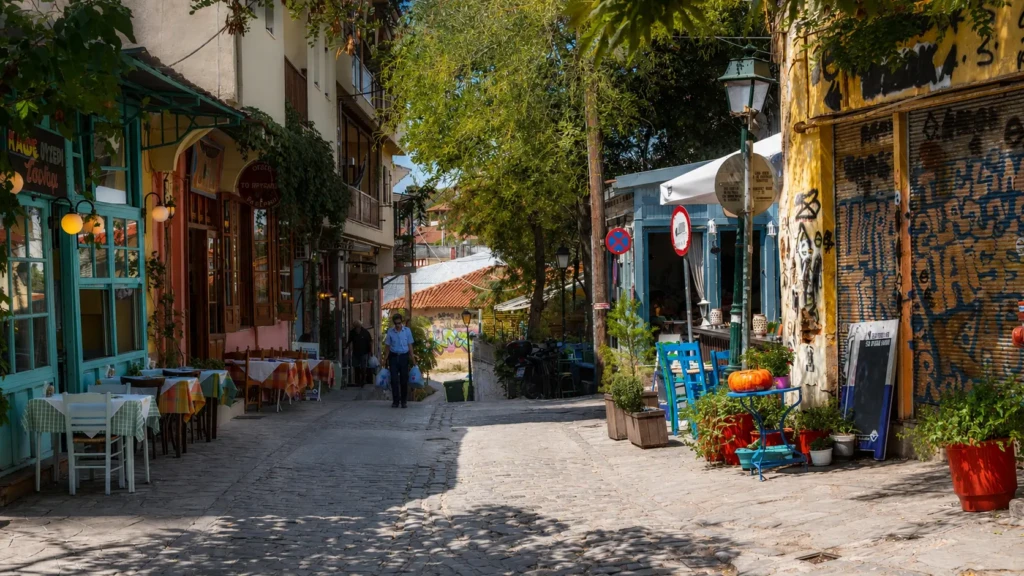
The central square of the Tsinari area Thessaloniki is small by most standards, but its importance to the neighbourhood is enormous. Shaded by trees, lined with the tables of surrounding cafes and tavernas, and paved with the same worn stone as the streets that feed into it, the square functions as an outdoor living room for the entire neighbourhood.

Children play here in the late afternoon while their parents drink coffee at the surrounding tables. Elderly residents occupy the benches and watch the evening arrive. Cats navigate between table legs. The social dynamics of the square have not changed fundamentally in a hundred years, and this continuity is what makes the Tsinari area Thessaloniki feel so remarkably authentic.

The Cobblestone Network

The streets radiating from the square are narrow cobblestone lanes lined with traditional houses, many of them featuring the distinctive overhanging upper storeys (sachnisi) of Ottoman-era residential architecture. Walking these lanes is an experience of constant visual surprise: a doorway framed by flowering jasmine, a wooden balcony painted in faded blue, a glimpse of the gulf between rooftops, a tiny chapel tucked into a corner.

The Tsinari area Thessaloniki is best explored on foot, without a fixed destination, allowing the streets to lead where they will. The neighbourhood is small enough that you cannot get genuinely lost, and every turn eventually leads back to the square or to one of the wider routes that connect Ano Poli to the city below.

Visiting the Tsinari Area

Best times:

  • Late afternoon to evening: The tavernas begin setting up outdoor tables around 6:00 PM, and the atmosphere peaks between 8:00 PM and 11:00 PM. This is the ideal time to experience the Tsinari area Thessaloniki at its most alive.
  • Sunday morning: A quieter experience, with locals emerging for coffee and the neighbourhood at its most relaxed and intimate.
  • Spring and early autumn: The outdoor dining season when the tables fill the square and the cobblestone lanes, and the temperature is perfect for sitting outside late into the evening.

Getting there: Walk uphill from the city centre (30 to 40 minutes) through the narrowing streets of Ano Poli, or take bus lines 22 and 23. On foot from Portara, the walk is approximately 10 minutes.

What to eat: Grilled meze, stuffed vine leaves, local sausage, bouyiourdi, grilled peppers, and whatever the kitchen made fresh that day. Pair everything with tsipouro or local Macedonian wine.

What to expect: This is not a polished, renovated tourist quarter. The Tsinari area Thessaloniki is a real neighbourhood where people live, and its charm comes precisely from that authenticity. Prices are fair, service is warm but unhurried, and English is spoken with varying degrees of confidence.

Combine with: Portara, the Monastery of Vlatadon, the Byzantine churches of Ano Poli, and a sunset walk to Eptapirgio. The Tsinari area Thessaloniki sits naturally at the centre of any Ano Poli itinerary, and the tavernas here are the perfect place to eat after an afternoon of exploring the upper town.

The plane tree still stands, the tables are still set, and the neighbourhood still gathers. The Tsinari area Thessaloniki does not need to reinvent itself. It simply continues.

Renting in the Tsinari Area

The Tsinari area Thessaloniki is one of the most sought-after residential pockets in Ano Poli for people who want to live inside a neighbourhood rather than merely near one. The houses and apartments here are set along cobblestone lanes, many of them featuring traditional architectural details: wooden balconies, painted facades, and small garden courtyards. The daily rhythm of the neighbourhood, with its morning coffee rituals, afternoon quiet, and evening taverna life, creates a quality of daily experience that is impossible to replicate in the modern city below.

Rental options range from small apartments in traditional buildings to rooms in restored heritage houses. Prices are moderate by Thessaloniki standards, typically lower than the city centre but reflecting the neighbourhood’s desirability and unique character. The area is popular with artists, writers, graduate students, and international residents who prioritise atmosphere and authenticity.

The practical trade-off is the hill: the Tsinari area is accessible from the centre on foot (30 to 40 minutes uphill) or by bus lines 22 and 23. Daily errands require a trip to the lower city for major shopping, though the neighbourhood itself has small shops and, of course, some of the best taverna food in Thessaloniki. For anyone willing to embrace the rhythm of Upper Town life, renting in the Tsinari area is one of the most rewarding living experiences the city offers.

According to ThessNest market data, one-bedroom apartments and small traditional homes in Tsinari usually cost €300 to €450 per month. The area is a strong choice for postgraduate students, Erasmus+ visitors who prefer local atmosphere, and digital nomads looking for a quieter long-stay neighbourhood with personality.


Looking for a place to stay in the Tsinari area? Browse verified rental listings, student housing, Erasmus+ accommodation, and digital-nomad stays on ThessNest. Whether you are an Erasmus+ student, international student, or digital nomad planning a flexible stay in Thessaloniki, ThessNest connects you with trusted hosts across the city.

Own a property in Ano Poli? List your property on ThessNest and reach international students, Erasmus+ tenants, and digital nomads looking for their next home in Thessaloniki.


The plane tree still stands, the tables are still set, and the neighbourhood still gathers. The Tsinari area Thessaloniki does not need to reinvent itself. It simply continues.

Frequently Asked Questions

The Tsinari area is highly sought after for its authenticity. According to ThessNest market data, renting a one-bedroom apartment or a small traditional home here usually costs between €300 and €450 per month. It offers a great balance of affordability and unique neighbourhood charm. For rent in Tsinari Ano Poli Thessaloniki, the best fit is usually a furnished long-stay apartment for someone who values atmosphere over quick access to nightlife.

Tsinari is popular with postgraduate students, writers, and those who prefer a more mature, bohemian atmosphere compared to the intense student hubs like Navarinou. The walk to the university takes about 25 minutes. ThessNest lists several quiet, long-term rentals in this district.

While Tsinari has small local shops, bakeries, and its famous tavernas, most residents head down to the city centre or Egnatia Street for major supermarket shopping. The area is well-served by local buses for the uphill return trip.

Neıgborhoods

Explore related neighborhoods

Continue with the neighborhood explorer to compare areas.

More city guides

Search

July 2026

  • M
  • T
  • W
  • T
  • F
  • S
  • S
  • 1
  • 2
  • 3
  • 4
  • 5
  • 6
  • 7
  • 8
  • 9
  • 10
  • 11
  • 12
  • 13
  • 14
  • 15
  • 16
  • 17
  • 18
  • 19
  • 20
  • 21
  • 22
  • 23
  • 24
  • 25
  • 26
  • 27
  • 28
  • 29
  • 30
  • 31

August 2026

  • M
  • T
  • W
  • T
  • F
  • S
  • S
  • 1
  • 2
  • 3
  • 4
  • 5
  • 6
  • 7
  • 8
  • 9
  • 10
  • 11
  • 12
  • 13
  • 14
  • 15
  • 16
  • 17
  • 18
  • 19
  • 20
  • 21
  • 22
  • 23
  • 24
  • 25
  • 26
  • 27
  • 28
  • 29
  • 30
  • 31
Size
Price
Amenities

Compare listings

Compare

Compare experiences

Compare

Compare listings

Compare

Compare experiences

Compare
Search

July 2026

  • M
  • T
  • W
  • T
  • F
  • S
  • S
  • 1
  • 2
  • 3
  • 4
  • 5
  • 6
  • 7
  • 8
  • 9
  • 10
  • 11
  • 12
  • 13
  • 14
  • 15
  • 16
  • 17
  • 18
  • 19
  • 20
  • 21
  • 22
  • 23
  • 24
  • 25
  • 26
  • 27
  • 28
  • 29
  • 30
  • 31

August 2026

  • M
  • T
  • W
  • T
  • F
  • S
  • S
  • 1
  • 2
  • 3
  • 4
  • 5
  • 6
  • 7
  • 8
  • 9
  • 10
  • 11
  • 12
  • 13
  • 14
  • 15
  • 16
  • 17
  • 18
  • 19
  • 20
  • 21
  • 22
  • 23
  • 24
  • 25
  • 26
  • 27
  • 28
  • 29
  • 30
  • 31
Size
Price
Amenities