
City Guides

Eptapirgio Thessaloniki

living near Eptapirgio Ano Poli Thessaloniki

If you are considering living near Eptapirgio Ano Poli Thessaloniki, you are looking at one of the most historically rich areas of the city. The city does not end; it climbs. Behind the modern apartment blocks and the commercial avenues, Thessaloniki rises toward the mountain, pulling the streets into steep inclines and sharp turns until they reach the Byzantine walls. And crowning those walls is Eptapirgio Thessaloniki the Fortress of Seven Towers. It is the physical crown of the city, a place where Byzantine military engineering, Ottoman administration, 20th-century political imprisonment, and 21st-century cultural reclamation all occupy the same stones. If you live in Thessaloniki and you have not climbed to Eptapirgio Thessaloniki, you have not yet seen the city from the perspective it was built to be seen from.

The History Behind the Walls

Byzantine Origins

The fortress sits on the site of the ancient acropolis of Thessaloniki, the highest defensible point of the city since antiquity. The northern section of Eptapirgio Thessaloniki, including its oldest towers and connecting curtain walls, dates to the late 4th century AD, constructed during the reign of Emperor Theodosius I as part of the massive fortification programme that enclosed the entire city. The southern towers were added during the 12th century, and the complex was further reinforced and rebuilt during the Palaiologan dynasty in the 14th century, when Thessaloniki was one of the most important cities of the late Byzantine Empire.

The name itself is a curiosity. “Eptapirgio” means “Seven Towers” in Greek, yet the fortress actually contains ten towers. The name was likely adopted to echo the famous Yedikule fortress in Constantinople (modern Istanbul), linking this provincial stronghold to the imperial capital. The Ottoman Turks, who conquered the city in 1430, kept the parallel name “Yedi Kule,” meaning exactly the same thing. Both names survive to this day, and both are used by locals when referring to Eptapirgio Thessaloniki.

Ottoman and Modern Eras

After the Ottoman conquest, the fortress became the seat of the city’s garrison commander and served as a military stronghold for over four centuries. In the 1890s, the complex was converted into a prison, a role it would fulfil for nearly a century. The prison at Eptapirgio Thessaloniki held not only common criminals but also political prisoners during some of the darkest chapters of modern Greek history: the Metaxas dictatorship of 1936, the Nazi occupation during World War II, the Greek Civil War, and the military junta of 1967 to 1974.

The notorious conditions of the Yedi Kule prison left a deep mark on Greek culture. The fortress appears repeatedly in rebetika music, the urban folk songs of the Greek underworld, where it is depicted as a place of suffering, injustice, and resilience. These songs gave Eptapirgio Thessaloniki a cultural weight that extends far beyond its architectural significance.

The prison finally closed in 1989, and the site was transferred to the Greek Ministry of Culture. Restoration and archaeological work began immediately and continues to this day, gradually transforming the fortress from a place of confinement into a public cultural space.

What You Will See

The Walls and Towers

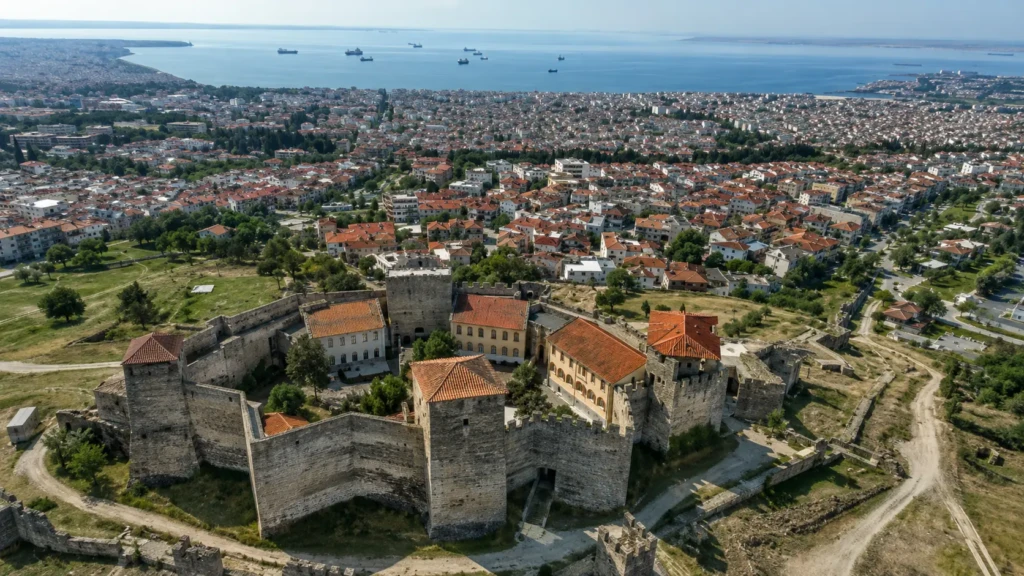
The most immediate impression of Eptapirgio Thessaloniki is one of scale. The walls are enormous, built from a combination of stone and brick in the distinctive Byzantine masonry technique that alternates courses of each material. The ten towers vary in age and construction style, creating a visible archaeological timeline in the stonework itself. The oldest sections, dating to the Theodosian period, use massive cut blocks; the later Palaiologan additions feature more refined brickwork with decorative patterns.

Walking along the perimeter of the walls, you can trace the full defensive circuit and understand how the fortress controlled access to the upper city. The main gateway, with its arched entrance and flanking towers, remains intact and gives a powerful sense of what it meant to approach this place when it was an active military installation.

The Panoramic Views

The single most compelling reason to visit Eptapirgio Thessaloniki is the view. From the highest platform, you can see the entire city laid out below: the grid of the modern centre, the waterfront promenade curving along the coast, the port with its cranes and cargo ships, and the Thermaic Gulf stretching to the horizon. On clear days, the snow-capped peaks of Mount Olympus are visible to the southwest. At sunset, the light turns the gulf gold and the city takes on a quality that photographs cannot fully capture.

This is the view that Thessaloniki was designed around. The city grew outward and downward from this point, and standing here you understand the geography of the place in a way that is impossible from street level.

The Interior Spaces

Inside the fortress, ongoing restoration has opened several areas to visitors. The central courtyard, once the exercise yard of the prison, is now an open public space used for cultural events and temporary exhibitions. Some of the former cell blocks have been partially restored, and interpretive panels document the site’s layered history from Byzantine garrison to Ottoman stronghold to 20th-century prison.

Visiting Eptapirgio Thessaloniki

How to Get There

Eptapirgio Thessaloniki sits at the top of Ano Poli (the Upper Town), and reaching it is part of the experience. The most rewarding approach is on foot, climbing through the narrow cobblestone streets of the old quarter. From the city centre, the walk takes approximately 40 to 50 minutes uphill, passing through some of the most atmospheric streets in the city.

If you prefer public transport, bus lines 22 and 23 serve Ano Poli and stop within a short walk of the fortress. A taxi from the centre costs approximately 5 to 7 euros.

Best Times to Visit

  • Sunset: The single best time to experience Eptapirgio Thessaloniki. Arrive 30 to 45 minutes before sunset, explore the walls, and watch the light change over the gulf. The atmosphere at this hour is extraordinary.
  • Early morning: Quiet, cool, and excellent for photography. The light on the eastern-facing walls is particularly good before 9:00 AM.
  • Spring and autumn: The most comfortable seasons for the uphill walk. Summer midday visits are hot and exposed.

What to Combine It With

A visit to Eptapirgio Thessaloniki combines naturally with a walk through the wider Ano Poli neighbourhood. On the way up or down, you can visit the Monastery of Vlatadon, the Tsinari area with its traditional cafes and tavernas, the Byzantine churches scattered through the cobblestone streets, and the traditional Ottoman-era houses that give the upper town its distinctive character.

The walk down from the fortress through the old quarter, particularly in the late afternoon, is one of the finest urban walks in Greece. The streets are narrow, the houses lean slightly inward, cats sleep on doorsteps, and the city appears and disappears between the buildings as you descend.

Why Eptapirgio Thessaloniki Matters

For international students and newcomers, Eptapirgio Thessaloniki offers something that few European cities can match: a place where 1,600 years of continuous urban history are compressed into a single site that you can walk through in an afternoon. The fortress is not a museum behind glass. It is open stonework under open sky, and you are free to touch the walls, sit on the ramparts, and watch the same sea that Byzantine emperors and Ottoman commanders watched from the same vantage point.

The view alone justifies the climb. But the real value of Eptapirgio Thessaloniki is the perspective it gives you on the city you are living in. From here, Thessaloniki makes sense as a whole: the waterfront, the grid, the hills, the gulf, and the mountains beyond. Come here once, and you will come back.

Living Near Eptapirgio

The streets surrounding Eptapirgio Thessaloniki represent the quietest and most atmospheric residential area in the city. When it comes to living near Eptapirgio Ano Poli Thessaloniki, it means residing at the top of the Upper Town, in a neighbourhood of traditional stone-and-timber houses, narrow cobblestone lanes, and views that extend across the entire Thermaic Gulf. The area is genuinely residential: families have lived here for generations, and the pace of life is slower than anywhere else in the city.

Housing near Eptapirgio ranges from small restored heritage homes with traditional courtyards to modest apartments in low-rise buildings. Rental prices are generally lower than the city centre, reflecting the distance from the commercial core and the uphill commute. The trade-off is the location: while the neighbourhood is peaceful and stunningly beautiful, reaching the centre on foot takes 40 to 50 minutes downhill (and longer coming back up). Bus lines 22 and 23 connect Ano Poli to the centre, but service frequency can be limited.

This area is best suited to people who prioritise tranquility, heritage character, and natural beauty over nightlife convenience. Writers, artists, remote workers, and anyone seeking an escape from urban noise will find the Eptapirgio neighbourhood deeply rewarding. For Erasmus students, it offers an experience of Thessaloniki that few international residents ever discover.

According to ThessNest platform data, apartments and traditional homes near Eptapirgio usually range from €250 to €450 per month. For postgraduate students, Erasmus+ visitors who prefer quiet, and digital nomads who work from home, the area offers excellent value as long as the uphill commute is acceptable.


Looking for a place to stay in Ano Poli? Browse verified rental listings, student housing, Erasmus+ accommodation, and digital-nomad stays on ThessNest. Whether you are an Erasmus+ student, international student, or digital nomad planning a flexible stay, living near Eptapirgio Ano Poli Thessaloniki offers an unforgettable experience, and ThessNest connects you with trusted hosts across the city.

Own a property in the Upper Town? List your property on ThessNest and reach international students, Erasmus+ tenants, and digital nomads looking for their next home and dreaming of living near Eptapirgio Ano Poli Thessaloniki.


The view alone justifies the climb. But the real value of Eptapirgio Thessaloniki is the perspective it gives you on the city you are living in. From here, Thessaloniki makes sense as a whole: the waterfront, the grid, the hills, the gulf, and the mountains beyond. Come here once, and you will come back.

Frequently Asked Questions

Renting near Eptapirgio is generally more affordable than the city centre. According to ThessNest platform data, apartments and traditional homes in this Upper Town area typically range from €250 to €450 per month, offering excellent value for those who appreciate heritage living.

It is best for postgraduate students, Erasmus+ visitors, remote workers, and digital nomads who prefer a quiet, village-like atmosphere over the busy city centre. Living near Eptapirgio Ano Poli Thessaloniki provides a unique heritage environment, but residents should be prepared for steep uphill walks and limited bus schedules. ThessNest lists verified long-term and flexible rentals in Ano Poli.

Walking downhill from Eptapirgio to the city centre (Aristotelous Square) takes about 25 to 30 minutes. Walking back up can take 40 to 50 minutes due to the steep incline. Bus lines 22 and 23 connect the area to the centre.

Neıgborhoods

Explore related neighborhoods

Continue with the neighborhood explorer to compare areas.

More city guides

Search

June 2026

  • M
  • T
  • W
  • T
  • F
  • S
  • S
  • 1
  • 2
  • 3
  • 4
  • 5
  • 6
  • 7
  • 8
  • 9
  • 10
  • 11
  • 12
  • 13
  • 14
  • 15
  • 16
  • 17
  • 18
  • 19
  • 20
  • 21
  • 22
  • 23
  • 24
  • 25
  • 26
  • 27
  • 28
  • 29
  • 30

July 2026

  • M
  • T
  • W
  • T
  • F
  • S
  • S
  • 1
  • 2
  • 3
  • 4
  • 5
  • 6
  • 7
  • 8
  • 9
  • 10
  • 11
  • 12
  • 13
  • 14
  • 15
  • 16
  • 17
  • 18
  • 19
  • 20
  • 21
  • 22
  • 23
  • 24
  • 25
  • 26
  • 27
  • 28
  • 29
  • 30
  • 31
Size
Price
Amenities

Compare listings

Compare

Compare experiences

Compare

Compare listings

Compare

Compare experiences

Compare
Search

June 2026

  • M
  • T
  • W
  • T
  • F
  • S
  • S
  • 1
  • 2
  • 3
  • 4
  • 5
  • 6
  • 7
  • 8
  • 9
  • 10
  • 11
  • 12
  • 13
  • 14
  • 15
  • 16
  • 17
  • 18
  • 19
  • 20
  • 21
  • 22
  • 23
  • 24
  • 25
  • 26
  • 27
  • 28
  • 29
  • 30

July 2026

  • M
  • T
  • W
  • T
  • F
  • S
  • S
  • 1
  • 2
  • 3
  • 4
  • 5
  • 6
  • 7
  • 8
  • 9
  • 10
  • 11
  • 12
  • 13
  • 14
  • 15
  • 16
  • 17
  • 18
  • 19
  • 20
  • 21
  • 22
  • 23
  • 24
  • 25
  • 26
  • 27
  • 28
  • 29
  • 30
  • 31
Size
Price
Amenities