City Guides

Monastery of Vlatadon Thessaloniki

Monastery of Vlatadon Thessaloniki

Hidden in the quiet residential streets of Ano Poli, behind a modest entrance that most passers-by would walk past without noticing, lies one of the most historically significant religious sites in southeastern Europe. The Monastery of Vlatadon Thessaloniki is the only Byzantine monastery in the city that has remained in continuous operation since its founding in the 14th century. It is a UNESCO World Heritage Site, a centre of theological scholarship, and a place of extraordinary stillness in a city that rarely stands still. For students, travellers, and residents who take the time to find it, the Monastery of Vlatadon Thessaloniki offers something that few urban sites can: a genuine encounter with the living traditions of Byzantine Christianity.

A History That Begins with the Apostles

The Tradition of Saint Paul

According to a tradition that dates back centuries, the Monastery of Vlatadon Thessaloniki was built on the site where the Apostle Paul preached to the residents of Thessaloniki during his second missionary journey around 51 AD. While historians debate the exact location, the association with Paul has given the monastery a spiritual significance that extends far beyond its physical boundaries. It is also historically linked to the house of Jason, who hosted the Apostle during his time in the city, as described in the Acts of the Apostles.

Whether or not the precise location is historically confirmed, the tradition has shaped the identity of the Monastery of Vlatadon Thessaloniki for its entire existence. Pilgrims, scholars, and believers have come here for nearly 700 years drawn by this connection to the earliest days of Christianity in Europe.

The 14th-Century Foundation

The monastery as it stands today was founded between 1351 and 1371 by the brothers Dorotheos and Markos Vlattis, who were disciples of Saint Gregory Palamas, the influential theologian and Archbishop of Thessaloniki. Dorotheos Vlattis later became the Metropolitan of Thessaloniki, and the monastery he established quickly became one of the most important religious centres in the city.

The founding of the Monastery of Vlatadon Thessaloniki coincided with the cultural and artistic flourishing known as the Palaiologan Renaissance, a period when Thessaloniki was one of the leading centres of Byzantine art, theology, and intellectual life. The monastery was both a product of this renaissance and a contributor to it, housing scholars, producing manuscripts, and serving as a place of spiritual and intellectual retreat.

Ottoman Period and Survival

After the Ottoman conquest of Thessaloniki in 1430, many of the city’s monasteries were destroyed or converted to other uses. The Monastery of Vlatadon Thessaloniki survived, largely because the monks cooperated with the new authorities, ensuring the monastery’s continued operation. It maintained a privileged status throughout the Ottoman period, continuing its religious functions even as the city around it was transformed.

During parts of the Ottoman era, some of the monastery’s frescoes were hammered and covered with plaster when sections of the complex were briefly used as a mosque. Despite this, the core structures and many of the artistic treasures survived, making the Monastery of Vlatadon Thessaloniki a rare example of unbroken Byzantine monastic continuity.

Architecture and Art

The Katholikon

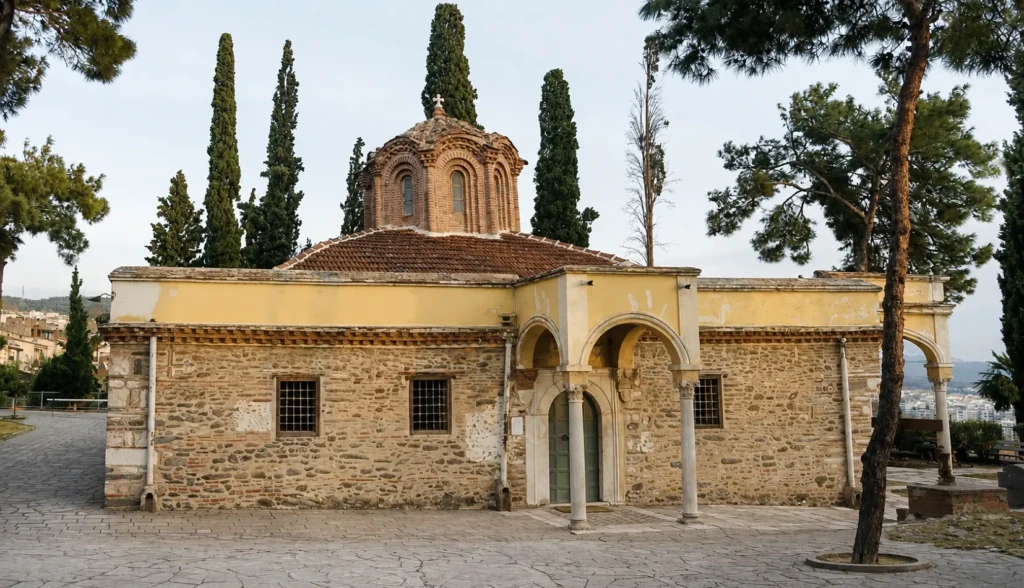
The main church of the Monastery of Vlatadon Thessaloniki, known as the katholikon, is the only original Byzantine structure that remains from the 14th-century foundation. It is built in the cross-in-square plan, a distinctively Byzantine architectural form, but with an unusual variation: the dome is supported by the sanctuary walls and two western pillars rather than the four columns typical of this style. This structural innovation gives the interior an unexpectedly spacious quality for its modest external dimensions.

The Frescoes

The interior walls of the katholikon contain wall paintings dating primarily to the period between 1360 and 1380, reflecting the artistic style of the Palaiologan Renaissance. These frescoes are characterised by their emotional expressiveness, rich colouring, and sophisticated use of light and shadow, qualities that distinguish late Byzantine painting from earlier, more rigid styles. While some sections have been damaged or lost over the centuries, what remains gives a powerful impression of the artistic culture that produced them.

Icons and Manuscripts

The monastery houses a significant collection of religious icons dating from the 12th to the 19th centuries, as well as ancient manuscripts and liturgical objects. These collections are not displayed in a museum-style setting but are part of the monastery’s living religious life, used in services and maintained by the monks as they have been for centuries.

The Gardens and the View

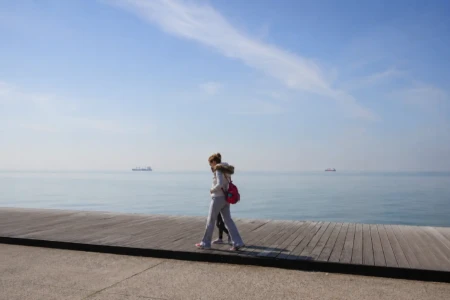
Perhaps the most immediately accessible aspect of the Monastery of Vlatadon Thessaloniki for casual visitors is its garden. Situated on the slope of Ano Poli, the monastery grounds include a walled garden that opens onto one of the most remarkable views in Thessaloniki. From the garden terrace, the entire lower city stretches out before you: the dense urban grid of the centre, the port, the Nea Paralia waterfront, and the Thermaic Gulf extending to the horizon.

The garden itself is quiet, shaded by ancient trees, and maintained with the careful simplicity that characterises monastic spaces. There are benches, flowering plants, and a sense of enclosure that makes the noise of the city below feel impossibly far away. Many residents of Thessaloniki, including students who live nearby, come to the garden of the Monastery of Vlatadon Thessaloniki simply to sit, read, or enjoy a few minutes of peace in one of the most beautiful outdoor spaces the city offers.

UNESCO World Heritage Status

The Monastery of Vlatadon Thessaloniki is inscribed on the UNESCO World Heritage List as part of the “Paleochristian and Byzantine Monuments of Thessaloniki,” a collective designation granted in 1988 that encompasses 15 sites across the city. This recognition places the monastery alongside the Rotunda, the Arch of Galerius, and the Church of Hagia Sophia as one of the defining monuments of Thessaloniki’s cultural heritage.

The UNESCO status reflects not only the architectural and artistic importance of the site but also its role in the broader history of Christianity and monasticism in the eastern Mediterranean. The Monastery of Vlatadon Thessaloniki is one of a very small number of Byzantine monasteries anywhere in Greece that has maintained continuous religious use from its founding to the present day.

The Patriarchal Foundation

Today, the Monastery of Vlatadon Thessaloniki holds the status of a patriarchal and stavropegic monastery, meaning it is under the direct jurisdiction of the Ecumenical Patriarchate of Constantinople rather than the local archdiocese. It is also home to the Patriarchal Foundation for Patristic Studies, an academic institution dedicated to the study of early Christian texts and theology. This scholarly function connects the monastery to its original intellectual mission, continuing the tradition of learning and theological inquiry that the Vlattis brothers established in the 14th century.

Visiting the Monastery

Location: In the heart of Ano Poli, accessible via the cobblestone streets of the Upper Town. Look for a modest entrance that opens into the monastery compound.

Opening hours: The monastery is generally open to respectful visitors during daylight hours. The church may have limited opening times; mornings are generally the best time to visit the interior.

Dress code: As an active religious site, modest clothing is expected. Shoulders and knees should be covered when entering the church.

Cost: Free admission.

How to get there: On foot from Portara or Tsinari (10 to 15 minutes), or by bus lines 22 and 23 to Ano Poli with a short walk. The uphill walk from the city centre takes approximately 35 to 45 minutes and is rewarding in itself.

Best combined with: A full Ano Poli walking tour including Portara, Eptapirgio fortress, the Tsinari area, and the Byzantine churches of the upper town. The Monastery of Vlatadon Thessaloniki sits naturally at the centre of this route, providing a peaceful midpoint between the energetic climb and the descent back to the modern city.

The monastery does not ask for your attention. It waits quietly behind its walls, as it has for nearly 700 years, for the people who are curious enough to find it.


Accommodation Near the Monastery

The streets surrounding the Monastery of Vlatadon Thessaloniki offer some of the most peaceful and atmospheric living in the city. The neighbourhood is genuinely residential, with a mix of traditional Ano Poli houses and low-rise apartment buildings set along quiet cobblestone lanes. The monastery’s garden is effectively your neighbourhood park, one of the most beautiful green spaces in Thessaloniki.

Accommodation options near Vlatadon range from small flats in traditional buildings to restored heritage homes with courtyards and garden views. Rental prices in this part of Ano Poli are typically lower than the city centre, reflecting the uphill location and the distance from the commercial core. What you gain in return is extraordinary: silence, beauty, views over the entire gulf, and the feeling of living in a village within a city.

The area is best suited to residents who value tranquility and character over convenience. The walk to the city centre takes 30 to 40 minutes downhill, and bus connections via lines 22 and 23 are available but not frequent. Remote workers, writers, academics, and anyone drawn to the contemplative atmosphere of a monastic neighbourhood will find the Vlatadon area deeply rewarding.

According to ThessNest data, traditional flats and small houses near Vlatadon Monastery typically range from €250 to €400 per month. For digital nomads, postgraduate students, and Erasmus+ students who prefer calm study conditions, this is one of the strongest value areas in Thessaloniki.


Looking for a place to stay in Ano Poli? Browse verified rental listings, student housing, Erasmus+ accommodation, and digital-nomad stays on ThessNest. Whether you are an Erasmus+ student, international student, or digital nomad planning a flexible stay in Thessaloniki, ThessNest connects you with trusted hosts across the city.

Own a property in the Upper Town? List your property on ThessNest and reach international students, Erasmus+ tenants, and digital nomads looking for their next home in Thessaloniki.


The monastery does not ask for your attention. It waits quietly behind its walls, as it has for nearly 700 years, for the people who are curious enough to find it.
Frequently Asked Questions

Renting near the Monastery of Vlatadon in Ano Poli is quite affordable. According to ThessNest data, rental prices for traditional flats and small houses in this area typically range from €250 to €400 per month. The lower prices reflect the uphill location away from the commercial centre. For accommodation near Vlatadon Ano Poli Thessaloniki, the strongest match is a quiet furnished flat or small heritage home for a longer stay.

It depends on your priorities. If you want nightlife and immediate proximity to the university, Navarinou or Hagia Sophia may be better. If you are a postgraduate student, Erasmus+ visitor, academic, or digital nomad seeking a peaceful green environment for studying or remote work, this area is exceptional. ThessNest lists quiet long-term and flexible rentals in this district.

Walking downhill to the city centre takes about 30 to 40 minutes and offers beautiful views. For the return trip uphill, residents typically use bus lines 22 and 23, which run regularly through Ano Poli.

Neıgborhoods

Explore related neighborhoods

Continue with the neighborhood explorer to compare areas.

More city guides

Search

July 2026

  • M
  • T
  • W
  • T
  • F
  • S
  • S
  • 1
  • 2
  • 3
  • 4
  • 5
  • 6
  • 7
  • 8
  • 9
  • 10
  • 11
  • 12
  • 13
  • 14
  • 15
  • 16
  • 17
  • 18
  • 19
  • 20
  • 21
  • 22
  • 23
  • 24
  • 25
  • 26
  • 27
  • 28
  • 29
  • 30
  • 31

August 2026

  • M
  • T
  • W
  • T
  • F
  • S
  • S
  • 1
  • 2
  • 3
  • 4
  • 5
  • 6
  • 7
  • 8
  • 9
  • 10
  • 11
  • 12
  • 13
  • 14
  • 15
  • 16
  • 17
  • 18
  • 19
  • 20
  • 21
  • 22
  • 23
  • 24
  • 25
  • 26
  • 27
  • 28
  • 29
  • 30
  • 31
Size
Price
Amenities

Compare listings

Compare

Compare experiences

Compare

Compare listings

Compare

Compare experiences

Compare
Search

July 2026

  • M
  • T
  • W
  • T
  • F
  • S
  • S
  • 1
  • 2
  • 3
  • 4
  • 5
  • 6
  • 7
  • 8
  • 9
  • 10
  • 11
  • 12
  • 13
  • 14
  • 15
  • 16
  • 17
  • 18
  • 19
  • 20
  • 21
  • 22
  • 23
  • 24
  • 25
  • 26
  • 27
  • 28
  • 29
  • 30
  • 31

August 2026

  • M
  • T
  • W
  • T
  • F
  • S
  • S
  • 1
  • 2
  • 3
  • 4
  • 5
  • 6
  • 7
  • 8
  • 9
  • 10
  • 11
  • 12
  • 13
  • 14
  • 15
  • 16
  • 17
  • 18
  • 19
  • 20
  • 21
  • 22
  • 23
  • 24
  • 25
  • 26
  • 27
  • 28
  • 29
  • 30
  • 31
Size
Price
Amenities