

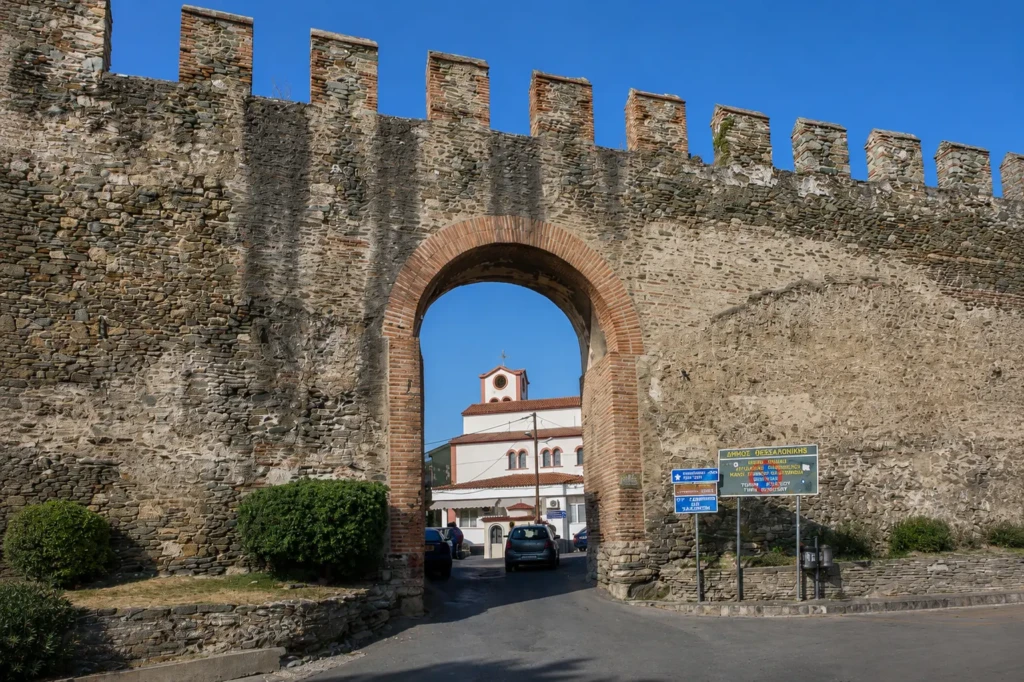
Every city has a threshold, a place where the modern world ends and something older begins. In Thessaloniki, that threshold has a name: Portara Thessaloniki. The word “Portara” means “big gate” in Greek, and it describes exactly what it is, a monumental arched gateway in the Byzantine fortification walls that once separated the lower city from the upper citadel. To pass through Portara Thessaloniki is to cross from the noise and traffic of the 21st century into the cobblestone labyrinth of Ano Poli, the Upper Town, where the streets are narrow, the houses are old, and the city feels like it did centuries ago.
Portara Thessaloniki is part of the extensive fortification system that once enclosed the entire city. These walls were originally constructed in the late Roman period under Emperor Theodosius I in the late 4th century AD, and were continuously maintained, repaired, and reinforced through the Byzantine era and into the Ottoman period. The northern section of the walls, where Portara Thessaloniki stands, protected the acropolis and the upper residential quarters of the city, providing a strategic connection between the lower urban area and the citadel at the summit.
The gate itself is an arched passageway built from massive cut stone blocks, flanked by sections of wall that still retain their original height in many places. It was designed as both a practical entrance for daily traffic and a defensible chokepoint that could be sealed during times of siege. Soldiers, merchants, monks, and ordinary residents passed through this gate for over a thousand years, making Portara Thessaloniki one of the most continuously used urban gateways in Greece.
Unlike much of lower Thessaloniki, which was devastated by the Great Fire of 1917, the area around Portara Thessaloniki and the wider Ano Poli district survived intact. The fire, which destroyed approximately two-thirds of the city centre, stopped before it reached the upper slopes, preserving the Ottoman-era houses, Byzantine churches, and the ancient walls that define the character of this neighbourhood. As a result, walking through Portara Thessaloniki today means entering one of the few parts of the city where the pre-fire urban fabric is still visible and still lived in.
The moment you pass through Portara Thessaloniki, the city transforms. The wide, traffic-filled avenues of the centre are replaced by narrow, winding cobblestone lanes, many of them too narrow for cars. These are the original “kalderimia,” the stone-paved paths that have served as the circulatory system of Ano Poli for centuries. They climb and twist unpredictably, opening suddenly into small squares with a church or a plane tree, then narrowing again into passages barely wide enough for two people to walk side by side.
Getting lost here is not a risk; it is the point. The cobblestone streets beyond Portara Thessaloniki are designed to be explored without a fixed destination. Every turn reveals a different view: a rooftop garden overflowing with bougainvillea, a cat asleep on a windowsill, a wooden balcony extending over the street in the traditional Ottoman style, or a sudden gap between houses that frames the Thermaic Gulf far below.
Portara Thessaloniki sits at the intersection of several of Ano Poli’s most important landmarks, making it the ideal starting point for exploring the upper town:
The most atmospheric way to reach Portara Thessaloniki is on foot from the city centre, climbing through the gradually narrowing and steepening streets of the transitional zone between the modern grid and the old quarter. The walk from Aristotelous Square takes approximately 30 to 40 minutes and is a journey through the city’s vertical geography. The noise fades, the buildings get smaller and older, the asphalt gives way to stone, and by the time you reach the gate, the transformation is complete.
This uphill approach is one of the defining walks of Thessaloniki, and it is one that residents of Ano Poli do daily without thinking of it as anything remarkable. For a newcomer, the first time you walk up to Portara Thessaloniki and pass through the arch into the old town is a moment that redefines your understanding of the city.
Once through Portara Thessaloniki, several routes branch out:
Getting there: Bus lines 22 and 23 serve Ano Poli with stops near the walls. On foot from the centre, allow 30 to 40 minutes uphill.
Accessibility: The cobblestone streets beyond Portara Thessaloniki are uneven and steep in places. Comfortable walking shoes are essential.
Cost: Free. The gate and walls are open public spaces accessible at all times.
Combine with: Trigoniou Tower, Eptapirgio fortress, Monastery of Vlatadon, Tsinari area, and the Byzantine churches of Ano Poli. A full circuit from Portara Thessaloniki through the upper town and back can fill a relaxed half-day.
Portara Thessaloniki is not the most famous landmark in the city. It does not appear on most postcards, and tour buses do not stop here. But for anyone who wants to understand what Thessaloniki actually is, beneath the modern surface, this gate is where that understanding begins. It is the point where the city’s deep history becomes tangible, where you can place your hand on stones that were laid sixteen centuries ago and walk through the same arch that Byzantine soldiers, Ottoman merchants, and Greek partisans walked through before you.
For Erasmus students and international residents, Portara Thessaloniki is a reminder that you are not just living in a modern European city. You are living in a city that has been continuously inhabited for 2,300 years, and the gate is still open.
The area immediately around Portara Thessaloniki is one of the most desirable residential pockets in Ano Poli. Living here means being at the threshold between the modern city and the ancient Upper Town, with the convenience of proximity to the lower city’s shops and transport while enjoying the quiet, heritage character of the cobblestone streets just inside the walls.
Apartments near Portara range from traditional houses with courtyards and Ottoman-era architectural details to renovated flats in small residential buildings. The area is quieter and more residential than the city centre, with a strong neighbourhood feel: locals know each other, small shops serve daily needs, and the pace of life is noticeably slower. Rental prices are moderate, generally lower than the city centre but reflecting the heritage appeal and unique character of the location.
The main practical consideration is the hill. Portara sits at the transition point where the city begins to climb steeply, and daily trips to the centre involve a 20 to 30-minute walk downhill (and a steeper return). Bus lines 22 and 23 provide connections to the centre. The area is best suited to residents who enjoy walking, who appreciate historical atmosphere, and who want a home that feels genuinely different from a standard city-centre flat.
According to ThessNest platform data, traditional apartments and small homes near Portara typically rent for €250 to €400 per month. The area is especially suitable for postgraduate students, Erasmus+ students who prefer heritage neighbourhoods, and digital nomads looking for calm long-stay housing.
Looking for a place to stay near Portara? Browse verified rental listings, student housing, Erasmus+ accommodation, and digital-nomad stays on ThessNest. Whether you are an Erasmus+ student, international student, or digital nomad planning a flexible stay in Thessaloniki, ThessNest connects you with trusted hosts across the city.
Own a property in Ano Poli? List your property on ThessNest and reach international students, Erasmus+ tenants, and digital nomads looking for their next home in Thessaloniki.
Renting near the historic Portara gate offers great value. According to ThessNest platform data, traditional apartments and small homes in this part of Ano Poli typically rent for €250 to €400 per month, making it an affordable option for those willing to live outside the commercial centre. For living in Ano Poli near Portara Thessaloniki, the main advantage is affordable heritage housing within walking distance of the lower city.
The primary challenge is the steep topography. Walking to the city centre takes about 20 minutes downhill, but the return journey is a significant uphill climb. However, bus lines 22 and 23 service the area. You can check exact transport links for specific properties on ThessNest.
Yes, if you prefer quiet heritage streets over nightlife density. Portara works especially well for postgraduate students, Erasmus+ students who want a local Ano Poli experience, and digital nomads who need a calm home base. ThessNest lists verified furnished and flexible rentals in this part of Ano Poli.
Yes, Ano Poli is a highly residential, close-knit community and is considered very safe. It has a village-like atmosphere where neighbours know each other, making it ideal for those seeking a peaceful living environment.
Continue with the neighborhood explorer to compare areas.
City Guides Aristotelous Square Thessaloniki There are squares in European cities that are important, and there are squares…
City Guides Athonos Area Thessaloniki Five minutes’ walk from Aristotelous Square, hidden in the commercial heart of the…
City Guides First Pier Walk Thessaloniki If there is one thing that defines daily life in Thessaloniki more…
City Guides Hagia Sophia Square Thessaloniki There is a corner of Thessaloniki’s city centre where a 7th-century Byzantine…
City Guides Museum Area Thessaloniki There is a part of Thessaloniki that feels different from the rest of…
City Guides Navarinou Axis Thessaloniki There is a part of Thessaloniki where ancient Roman ruins sit in the…
City Guides Tsimiski Street Thessaloniki Every city has a street that defines its commercial identity, a spine around…
City Guides Ladadika Area Guide: The Vibrant Heart of Thessaloniki Discover the historic Ladadika area in Thessaloniki. A…
Log in
Don't have an account? Register
Please enter your username or email address. You will receive a link to create a new password via email.
Register with your email
Do you already have an account? Log In
Log in
Don't have an account? Register
Please enter your username or email address. You will receive a link to create a new password via email.
Register with your email
Do you already have an account? Log In