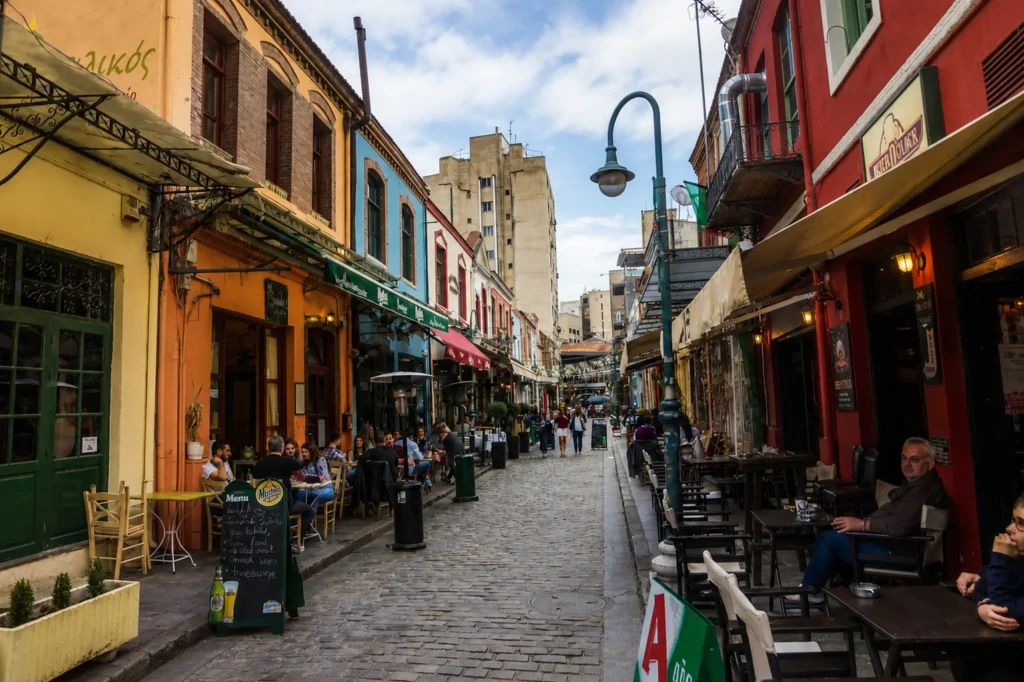
Walk through the lower city of Thessaloniki and you see a modern European grid: wide boulevards, concrete apartment blocks, glass-fronted shops. Walk uphill into Ano Poli and the city peels back by centuries. The streets narrow, the pavement turns to cobblestone, and the buildings shrink from anonymous modernist blocks into painted timber-framed houses with overhanging balconies, garden walls covered in jasmine, and doorways worn smooth by generations. The traditional architecture of Thessaloniki survives almost exclusively in this upper quarter, and exploring it is one of the most rewarding things you can do during your time in the city.
On 18 August 1917, a fire broke out in the centre of Thessaloniki and burned for 32 hours. By the time it was extinguished, approximately two-thirds of the city had been destroyed. Over 70,000 people lost their homes. The entire commercial, residential, and cultural heart of Thessaloniki was reduced to ash.
But the fire stopped before it reached the slopes of the Upper Town. The traditional architecture of Thessaloniki in Ano Poli survived because of geography: the steep hillside, the wider gaps between buildings on the slopes, and the stone fortification walls that acted as firebreaks. While the lower city was rebuilt on a modernist grid designed by French urban planner Ernest Hebrard, the Upper Town kept its medieval street pattern, its Ottoman-era houses, and its layered architectural heritage.
This accident of fire and topography is why Ano Poli exists as it does today, and why the traditional architecture of Thessaloniki can still be experienced as a living urban fabric rather than as isolated museum pieces.
The most distinctive element of the traditional architecture of Thessaloniki in Ano Poli is the Ottoman-era residential house, known locally as an “archontiko” when it belongs to a wealthier family. These houses share a set of recognisable features:
Beneath and alongside the Ottoman domestic architecture, the traditional architecture of Thessaloniki includes much older elements:
One of the best-preserved examples of the traditional architecture of Thessaloniki is the house where Mustafa Kemal Ataturk, the founder of modern Turkey, was born in 1881. Located in the Apostolou Pavlou area near Ano Poli, the house is a three-storey timber-framed residence from the 1860s that has been meticulously restored and maintained as a museum by the Turkish government. Its painted walls, wooden staircases, and period furnishings give an accurate impression of how the more prosperous Ottoman-era houses of the neighbourhood would have looked and felt.
Originally built in 1484, the Alaca Imaret is one of the most architecturally sophisticated Ottoman buildings in the city. Its name, meaning “colourful hospice,” refers to the polychrome brickwork and tile decoration on its exterior. While the building has undergone various restorations, it remains a powerful example of the Ottoman contribution to the traditional architecture of Thessaloniki and the multicultural layers that define Ano Poli.
Several houses in Ano Poli have been restored in recent decades by the Greek Ministry of Culture and private owners, using traditional materials and techniques. These restorations demonstrate the timber-frame construction methods, the plastering and painting techniques, and the woodworking traditions that created the traditional architecture of Thessaloniki. Some restored houses have been repurposed as cultural centres, small galleries, or guesthouses.
Since the late 1970s, Ano Poli has been designated as a “traditional settlement” under Greek heritage law, which imposes strict regulations on new construction, alterations to existing buildings, and demolitions. Building heights, materials, colours, and even signage are regulated to preserve the architectural and aesthetic character of the neighbourhood.
Despite these protections, the traditional architecture of Thessaloniki faces ongoing challenges. Many buildings remain in private hands and require expensive maintenance that owners cannot always afford. Some houses have been abandoned and fallen into disrepair. The municipality has undertaken operations to address unsafe structures while working to preserve the heritage fabric.
In recent years, there has been growing interest in rehabilitating abandoned or dilapidated buildings in Ano Poli, creating green spaces along the fortification walls, and improving public infrastructure without compromising the historic character of the neighbourhood. The balance between preservation and livability remains the central challenge, and the traditional architecture of Thessaloniki depends on getting this balance right.
The best way to experience the traditional architecture of Thessaloniki is on foot, without a fixed route, allowing the streets of Ano Poli to reveal their character at walking pace.
Where to look:
Best time to walk: Late afternoon, when the warm light brings out the colours of the painted facades and casts shadows from the overhanging balconies. Spring is ideal, when the garden walls are covered in flowering jasmine and bougainvillea.
Combine with: Portara, Eptapirgio fortress, the Tsinari area, the Monastery of Vlatadon, and the Byzantine churches. The traditional architecture of Thessaloniki is not a separate attraction; it is the built environment that connects all of these landmarks.
The houses of Ano Poli are not behind rope barriers or glass panels. They are lived in, walked past, and gradually understood. The traditional architecture of Thessaloniki asks only that you slow down enough to see it.

For those drawn to the traditional architecture of Thessaloniki, Ano Poli offers a rare opportunity: the chance to actually live inside heritage buildings rather than merely admire them from the outside. Several restored Ottoman-era houses and traditional residences are available for rent, offering an experience of domestic life that connects directly to the neighbourhood’s architectural history.
Renting a heritage home in Ano Poli typically means living in a building with timber-framed walls, high ceilings, wooden floors, and perhaps a sachnisi balcony overlooking the street. Some restored homes include internal courtyards, garden spaces, and views over the city and the gulf. The charm is undeniable, but heritage properties also come with practical considerations: older plumbing, limited insulation in winter, and the maintenance demands of traditional materials.
Rental prices for heritage homes vary widely depending on the level of restoration, size, and location within Ano Poli. Well-restored properties command prices comparable to the city centre, while less-restored buildings can be surprisingly affordable. For architects, designers, history enthusiasts, and anyone who wants their home to have a story, renting in Ano Poli’s heritage quarter is one of the most distinctive living experiences Thessaloniki offers.
According to ThessNest listings, restored heritage homes in Ano Poli typically range from €350 to €600 per month, while simpler older flats can start around €250. These homes are a strong match for digital nomads, design-minded students, and Erasmus+ visitors who want a distinctive long-stay experience rather than a standard city-centre apartment.
Looking for a heritage home or apartment in Ano Poli? Browse verified rental listings, student housing, Erasmus+ accommodation, and digital-nomad stays on ThessNest. Whether you are an Erasmus+ student, international student, or digital nomad planning a flexible stay in Thessaloniki, ThessNest connects you with trusted hosts across the city.
Own a heritage property in the Upper Town? List your property on ThessNest and reach international students, Erasmus+ tenants, and digital nomads looking for their next home in Thessaloniki.
The houses of Ano Poli are not behind rope barriers or glass panels. They are lived in, walked past, and gradually understood. The traditional architecture of Thessaloniki asks only that you slow down enough to see it.

According to ThessNest listings, renting a traditional or restored Ottoman-era home in Ano Poli typically ranges from €350 to €600 per month, depending on the size and level of restoration. Unrenovated older flats in the same area can be found for as low as €250 per month. For Ano Poli Thessaloniki heritage homes for rent, prices depend heavily on restoration quality, heating, insulation, and access to the lower city.
Older heritage properties often have lower energy efficiency compared to modern apartments. When browsing traditional homes on ThessNest, it is advisable to ask the landlord about heating systems (gas vs electric) and whether the wooden window frames have been recently restored.
Yes. Many Erasmus+ students, international students, and digital nomads choose Ano Poli specifically for its architectural character and quiet atmosphere. Daily commutes to the university take about 30 minutes on foot, mostly downhill going there and uphill returning, so ThessNest recommends checking the exact walking route before booking.
Continue with the neighborhood explorer to compare areas.
City Guides Aristotelous Square Thessaloniki There are squares in European cities that are important, and there are squares…
City Guides Athonos Area Thessaloniki Five minutes’ walk from Aristotelous Square, hidden in the commercial heart of the…
City Guides First Pier Walk Thessaloniki If there is one thing that defines daily life in Thessaloniki more…
City Guides Hagia Sophia Square Thessaloniki There is a corner of Thessaloniki’s city centre where a 7th-century Byzantine…
City Guides Museum Area Thessaloniki There is a part of Thessaloniki that feels different from the rest of…
City Guides Navarinou Axis Thessaloniki There is a part of Thessaloniki where ancient Roman ruins sit in the…
City Guides Tsimiski Street Thessaloniki Every city has a street that defines its commercial identity, a spine around…
City Guides Ladadika Area Guide: The Vibrant Heart of Thessaloniki Discover the historic Ladadika area in Thessaloniki. A…
Log in
Don't have an account? Register
Please enter your username or email address. You will receive a link to create a new password via email.
Register with your email
Do you already have an account? Log In
Log in
Don't have an account? Register
Please enter your username or email address. You will receive a link to create a new password via email.
Register with your email
Do you already have an account? Log In